


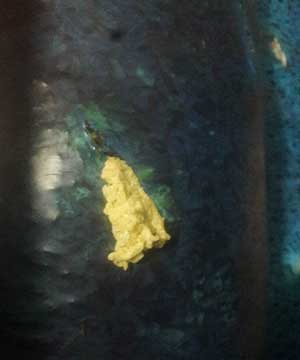
Sometimes oyster mushroom growers notice a strange yellow or orange mass appearing in the perforations of mushroom blocks or on nearby surfaces.
It may look like mold, but behave very differently.
In most cases, this is slime mold, not a fungal contamination of the substrate.
Understanding what slime mold is — and how it differs from Neurospora — helps avoid wrong decisions.
What is slime mold?
Slime molds (Myxogastria) are not fungi and not bacteria.
They are a separate group of living organisms that combine features of both.
You can read about them in scientific sources, but from a grower’s point of view, only a few things matter:
▶️ slime mold does not feed on the substrate itself,
▶️ it does not compete with mushroom mycelium,
▶️ it appears mainly in very humid environments,
▶️ it is usually a sign of external contamination, not a substrate problem.
Slime mold can look very different depending on humidity:
When dry, it resembles withered polyurethane foam or a dried yellow crust (photo above).
 When humidity is high, it may appear as a bright yellow or yellow-orange, slimy, jelly-like mass with an uneven surface (see photo).
One of its most distinctive features is that it can move.
Slime mold forms pseudopods and can slowly crawl across surfaces at a speed of about 1–2 centimeters (0.5-1 snch) per hour.
This movement is sometimes visible over several hours.
Most often, slime mold is found in greenhouses, near doors, walls, or ventilation openings, in perforations or outside (on plastic) of fully colonized oyster mushroom blocks.
It is rarely found inside the incubator during early incubation.
Directly — no. Slime mold does not infect the substrate and does not destroy oyster mushroom mycelium.
💡However, its appearance indicates that:
So while slime mold itself is not dangerous, its presence means the room needs attention.
This is one of the most common points of confusion.
By the way, when a slime mold dries out, it also forms spores. These spores can create a surface coating like the one shown in the photo, which can confuse growers even more.
Below, I’ve highlighted the main features that are typical for these organisms.
If the orange or yellow mass changes position over time, it is almost certainly slime mold.
If it stays fixed and spreads by forming new spots — this is fungal mold, often Neurospora.
 And honestly, from my experience, it’s often not the ability to move that helps most with identification, but the fact that the mass usually appears on the plastic film rather than inside the substrate.
▶️This is one of the clearest signs that you are dealing with a slime mold.
If slime mold is detected, a complete sanitation of the room is required.
Ideally, all mushroom blocks should be removed, and the walls, floor, racks, and equipment thoroughly disinfected.
Slime mold spores are very resilient, and even small residues left in the room can survive and cause the problem to return later.
If it is not possible to take the blocks out, disinfect only the empty surfaces and work very carefully to avoid getting disinfectants into the block perforations.
Chemicals that enter the substrate can damage the mycelium and reduce yield. To minimize this risk, you can place soft, damp paper (for example, kitchen paper towels) into the block holes before treatment and remove the paper after the room has been disinfected.
⚠️After disinfection, it’s important to correct the growing conditions that allowed the problem to appear in the first place.
This usually means reducing excessive humidity and improving air circulation.
Once air exchange is under control, adjusting humidity becomes much easier.
✅Start with ventilation.
As soon as air movement in the room becomes sufficient, oyster mushrooms begin to feel better, and humidity often decreases on its own — simply because moist, stale air is removed from the room more efficiently and replaced with fresh air.
📌If you want to understand this process in more detail, this article may help: How to ventilate a mushroom grow room?
Slime mold is not a substrate contamination and does not compete with oyster mushroom mycelium.
But it is a very clear sign that something is wrong with air exchange in the growing room. (Now you know what this is really about 😉)
Emoji guide: 📌 link | ✅ advice | ▶️ fact | 💡 important | ⚠️ warning