


A common question among growers is: "When will my mushrooms return?" Understanding the timing between flushes is key to planning your production cycle.
Typically, new primordia appear within 7 to 10 days after the first harvest.
However, this period can stretch or shrink depending on four critical factors:
To produce a second flush, the substrate must have enough water and nutrients.
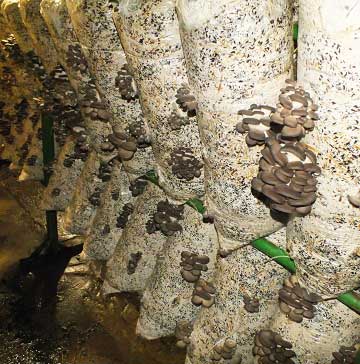
✅Initial Moisture:
During inoculation, your straw or husk should have a moisture content of 67–68%.
If the substrate is growing well, without spots, and water isn't seeping under the plastic, you can try increasing the humidity—first to 69%, then to 70%. If the substrate is doing well, this will lead to abundant second growth.
▶️If your bags feel very light after the first harvest, it means the first flush used up all the available water.
Can you soak the blocks? Honestly, soaking oyster mushroom blocks rarely works.
Unlike Shiitake, the structure of oyster substrate doesn't absorb water well once colonized, and soaking often leads to mold.
But you can try - what if it works?🤷♀️
✅Pro Tip: If the block is light but still has potential, try compacting the contents by hand, tamping it down to the bottom of the bag and re-tying it. This can sometimes trigger one last burst of growth.
💡The closer your parameters are to optimal, the faster the mycelium will recover.
The "Rest" Period: This time is necessary for the mycelium to restore its energy and for the hyphae to grow back toward the perforations.
The Cold Delay: If your growing room is too cold—below 12°C (53°F)—the appearance of the second flush will be delayed indefinitely. The mycelium simply "freezes" and waits for warmth.
Not all mushrooms play by the same rules:
Summer Strains: Some Pleurotus pulmonarius varieties bear fruit almost without interruption. You might see new pins just 1 or 2 days after harvesting the first bunch.
Intensive Strains: Many modern varieties give a massive first harvest and then "crash." Large farms often move these blocks outside after the first flush because keeping them in a climate-controlled room isn't profitable for a small second harvest.
The HK-35 Exception: This classic strain is famous for its stability. It often produces the same volume (about 10-12% yield) three or four times in a row.
The 'power' of your second wave depends on the nitrogen-to-carbon ratio in your substrate.
A lack of specific microelements can also act as a hidden bottleneck—the first flush might look fine, but the second one will fail because the substrate's mineral 'reserves' are empty.
Learning to work with substrate mixtures is essential because different raw materials provide different levels of microelements. By blending components, you ensure a balanced diet for the mycelium, leading to a faster and more massive second flush.
✅ If it’s summer and your blocks are still dense and white after two harvests but won't fruit further, try this 'summer trick':
Make a long vertical cut along the bag and slightly peel back the plastic edges to expose the surface, being careful not to damage the mycelium. You can see these long longitudinal cuts in the photo below.
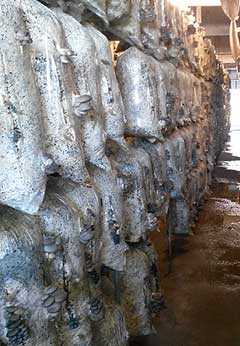
By exposing this new surface area and maintaining high humidity (89-90%), you can often trigger a vigorous third harvest from these fresh openings.
This is a great way to get an extra boost before wrapping up your farm work for the season.
If you’ve been waiting more than two weeks and see nothing, check for these issues:
1. Low Substrate Moisture: The most common reason. There was enough water for one big flush, but the "well ran dry."
2. Cold Temperatures: Below 12°C (53-54°F), the mycelium recovers too slowly.
3. Overheating & Stroma: If the room was too hot (above 20°C / 68°F), a thick white skin (stroma) might have grown under the film, blocking new primordia (pins).
📌Read more: What is stroma?
4. Clogged Slits: If you harvested too late and the room was filled with spores, they might have literally "sealed" the holes.
5. Low Substrate Nutrition or Mineral Deficiency:
Sometimes the raw material is simply too "poor" to support a second wave. If the substrate lacks enough nitrogen or critical minerals—like phosphorus—the mycelium will exhaust all its energy just to produce the first small harvest. In this case, the second flush simply won't form because the "pantry" is empty.
This is why experienced growers don't rely on just one type of raw material. Learning to create balanced substrate mixtures by combining different agricultural wastes is the best way to ensure consistent yields across all flushes.
📌Read more: How to Create the Perfect Substrate Mixture
Emoji guide: 📌 link | ✅ advice | ▶️ fact | 💡 important | ⚠️ warning