


Table of Contents
In the world of oyster mushroom cultivation, terminology can sometimes be confusing. Hobbyist growers often refer to the disinfection of straw in a lime solution as "pasteurization."
However, calling it that is technically incorrect.
📌I discuss the reasons for this in a separate article.
Before diving into the process, it’s essential to understand the equipment.
If you want to learn more about the technical design and construction,
📌check out our guide on Tunnel Structure and Design.
Professionally speaking, the design of a tunnel for oyster mushroom substrate is very similar to the tunnels used for button mushroom (Agaricus) compost.
💡However, the processes inside are quite different:
Button Mushroom Compost:
Requires a long fermentation process before it even enters the tunnel. This is necessary to transform the mixture of straw and manure into a specialized nutritional structure.
Oyster Mushroom Substrate:
The oyster mushroom feeds directly on the straw itself. It has no need for manure, which means the treatment regimes and temperatures are entirely different from those used for button mushrooms.
▶️Note: Interestingly, in some countries—Turkey, for example—the term "oyster mushroom compost" is still used to describe the substrate, even though the biological process is different.
The success of your substrate starts with the formula. Common bases include chopped straw, sunflower husks, and hay from various plants grown in your local area.
Oyster mushrooms are incredibly versatile; they can thrive on almost any agricultural residues rich in cellulose and lignin. Depending on what is available in your region, you can also use:
📌A detailed description of the main types of raw materials can be found here.
The key to a high-yielding substrate isn’t just the type of material, but its structure and nitrogen (N) content.
For optimal yields, your mix should have a nitrogen content of 6–0.7% (measured by the Kjeldahl method). The amount of hay or supplements you add depends entirely on this calculation.
The Kjeldahl method is a highly complex analysis that requires specialized equipment and specific chemical reagents. Even large-scale mushroom producers rarely perform this in-house; instead, such tests are outsourced to specialized agricultural laboratories.
If there isn’t a specialized lab in your area, I recommend a practical, step-by-step approach to adding nutritional supplements.
✅Start by adding 5% of the total mass, then gradually increase it—to 7%, 10%, and up to 15%—in subsequent batches. Carefully observe how the mycelium colonizes the substrate and monitor the resulting yields. This incremental method allows you to find the "sweet spot" for your specific raw materials without the need for expensive lab work.
We use lime or soda ash to raise the pH to 8–8.5. This alkaline environment acts as a chemical defense against initial mold growth.
To adjust the pH, start by preparing a concentrated lime solution. There are two common ways to apply it: you can either mix it directly into the water tank used for hydration, or apply the diluted solution separately after wetting each layer of straw.
✅The exact amount needed should be determined experimentally. I recommend measuring the pH level after the first transfer (turning). If the levels are still too low, you can apply additional lime solution during the process to reach the target alkalinity.
I recommend using plastic containers for handling lime.
⚠️Avoid iron or metal containers, as the alkaline solution will cause them to corrode rapidly.
Why can’t we just wet the straw and steam it immediately? Because of dormant spores.
Fungal and bacterial spores are like tiny armored bunkers. In their dry, "sleeping" state, some can survive temperatures above 100°C (212°F).
1. We soak the raw materials on a concrete pad, compacting each layer to ensure 70–75% moisture.
2. In the wet, warm pile, mold spores begin to swell and "hatch" (germinate).
3. We move the pile twice over three days. This saturates the substrate with oxygen and keeps the temperature between 40–55°C (104–131°F).
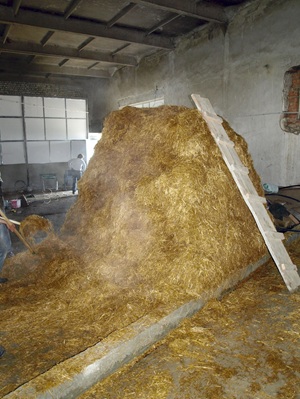
📷In this photo, you can see the tall straw pile steaming—it heated up well after the first transfer.
Once those spores have germinated, they lose their "armor."
▶️In this vulnerable state, they will be easily destroyed at a modest 65–70°C during pasteurization.
Once loaded into the tunnel, the substrate undergoes heat treatment.
💡The Goal: We reach 67–69°C (153–156°F) and hold it for 12–18 hours.
During this time, we keep the fresh air damper open by 10–15%.
This prevents the development of anaerobic microorganisms — the culprits behind the foul-smelling "black rot" during incubation.
In button mushroom (Agaricus) production, fermentation is vital to convert ammonia into microbial protein.
Since oyster mushrooms are wood-decaying (lignicolous) fungi that feed on the structural components of straw—cellulose and lignin—the raw material must be soft and well-hydrated.
This allows the mycelium to break down and utilize the substrate much more efficiently.
It is the turning process (transfers) that achieves this physical softening. Additionally, during this stage, various microorganisms consume the easily accessible nutrients that would otherwise feed contaminants, effectively starving them out.
▶️Once this is done, the bacteria have fulfilled their role, making any further cultivation through fermentation unnecessary.
Many growers spend an extra 20–36 hours keeping the substrate at 45–50°C (104–122°F) post-pasteurization. My experience (and that of many modern industrial farms) shows:
No Yield Difference:
Removing the fermentation stage does not decrease yield.
I attribute this to the fact that we cannot truly control which specific microorganisms will multiply during the fermentation stage. In a production environment, it remains unknown how these unpredictable microbial populations will ultimately interact with or affect the oyster mushroom mycelium.
Better Colonization:
Without fermentation, the substrate is often more uniform, and mycelium overgrowth is more consistent.
Efficiency: You save 1.5 days of fan operation and electricity.
✅My Advice: Skip the fermentation. If your pre-pasteurization "turns" were done correctly, the beneficial microflora has already done its job of consuming easy carbohydrates.
Some recommend "double steaming"—heating to 70°C, cooling, and heating again. The theory is that the cooling triggers spore germination for the second kill.
In a production environment, this is impossible to control. You risk provoking the growth of the very pathogens you're trying to kill without any guarantee of a second "hit." Stick to a single, high-quality cycle.
|
Stage |
Action |
Purpose |
|
Day 1 |
Soaking & Layering (pH 8.5) |
Hydration and chemical protection |
|
Day 2-3 |
Two Transfers (Turning) |
Oxygen saturation; "waking up" dormant spores |
|
Pasteurization |
12-18 hours 67–69°C (153–156°F) |
Destruction of "hatched" spores and competitors |
|
Cooling |
8-10 hours to reach 25–30°C (77–86°F) |
Preparation for inoculation (spawning) |
Emoji guide: 📌 link | ✅ advice | ▶️ fact | 💡 important | ⚠️ warning