


Table of Contents:
Why do mushrooms pinning, but not growing?
If oyster mushroom pins appear but stop growing, dry out, or turn into strange white masses instead of normal clusters, the problem is almost always conditions during incubation or fruiting.
Below is a practical explanation of what’s going wrong and what to do about it.
▶️ Oyster mushrooms can form primordia (early pins) and then suddenly stall.
Almost all pinning defects are caused by unstable or incorrect growing conditions, especially:
▶️A very common mistake:
Blocks are moved from incubation (warm, about 75–80% humidity) into a grow room that is much cooler with high humidity (around 88–95%).
What happens next:
Condensation forms on the primordia. They become wet, slimy, and literally suffocate under a thin film of water. These pins die, and mold quickly settles on them.
💡 Even a very thin, invisible layer of condensate is enough to kill primordia.
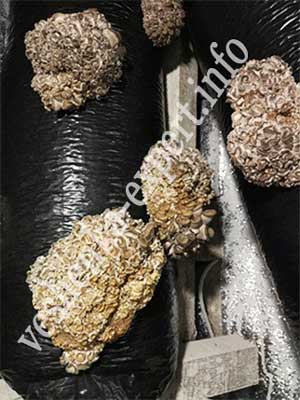
In the photo, you can see a gas exchange problem inside the mushroom block. The bags were placed too close to each other and overheated at the contact points.
When primordia started to form, the room temperature was about 16 degrees Celsius (60 degrees Fahrenheit) with very high humidity, around 95 percent.
At this humidity level, condensation forms regularly, and the pins get wet. Under these conditions, primordia stop developing, and normal oyster mushrooms do not form.
▶️Another frequent cause of deformed growth:
Water getting directly into the slots — for example, from misting nozzles installed incorrectly.
⚠️ Humidification must work only through the air ducts, never directly onto the blocks.
If pins separate into individual mushrooms but then turn yellow, shrink, and dry, check the following:
Before the first flush, block moisture should be about 68–70%.
Low substrate moisture is usually caused by improper heat treatment or by low air humidity during incubation, particularly when humidity is around 60–65 percent.
💡 A well-pasteurized substrate can safely have up to 73–74% moisture if it colonizes evenly and without defects.
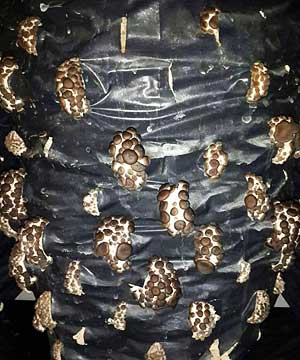
Excessive perforation increases evaporation.
The substrate dries out too quickly, the mycelium cannot develop properly, and even when pins do appear, they often dry out.
In the photo, you can see pins forming in numerous perforations.
Each cluster has only a few mushrooms, and many of these pins will eventually die because the mycelium simply cannot feed them all.
▶️Nutrients are delivered to the mushrooms through the mycelial network in a dissolved form.
Strong air movement near the slots dries pins very quickly.
✅Check whether:
In this case, the mushroom pins turn yellow and stop developing. If you pull one off and gently squeeze it, water appears inside. A very common reason for this is sharp fluctuations in temperature and humidity, often caused by ventilation working on a timer or being switched on only a few times a day.
When the ventilation is turned off, humidity drops. When it is turned on again, humidity rises quickly and condensation forms on the primordia. Sometimes this condensation is a thin, continuous film that is almost invisible; sometimes it appears as individual droplets.
▶️Even if the pins are killed by this film of condensation, they dry out only after a few days. That is why many mushroom growers do not believe that the real cause of pin drying was a layer of water.
💡The climate in the grow room must be stable.
Ventilation should run continuously, while humidity and temperature should be controlled by sensors and controllers.
Sometimes a white, fluffy or foam-like mass appears in the slot but never turns into mushrooms.
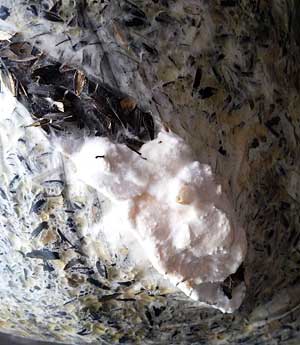
▶️ This is stroma — overgrown mycelium that failed to differentiate into fruiting bodies.
Under the film, the substrate remains clean and well colonized, with no signs of stroma.
There are two main reasons.
Sharp changes in temperature, humidity, or gas exchange cause the mycelium to seal the slot, protecting the interior.
✅What to do:
Carefully remove the stroma and move the bags into proper fruiting conditions.
Mushrooms will usually grow from other slots that do not have a hard stroma crust.
⚠️ Direct water entering the slots also causes undifferentiated stroma growth.
If conditions were disturbed during the very early stage of primordia formation, the morphogenesis breaks down.
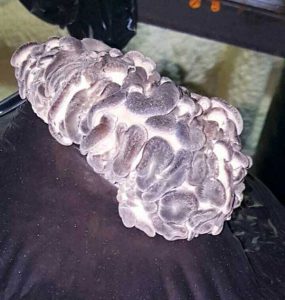
▶️ Result: cone-like white growths that never split into individual mushrooms.
📌Read more here.
Mycelium that is homemade or multiplied too many times can lose its ability to form fruiting bodies.
⚠️ Such mycelium continues growing vegetatively, producing:
• cotton-like masses
• cones
• cauliflower-like clusters
These structures contain many underdeveloped mushrooms but never form proper clusters.
Sometimes balls are formed instead of pins - the mass merges into one cluster, which looks like a cauliflower inflorescence, but fruiting bodies do not form from it.
💡 Despite rumors about “viral diseases,” most cases are not infections.
If a strong, healthy cluster grows normally from another slot, the mycelium itself is usually fine.
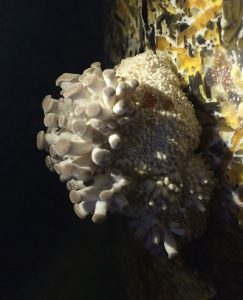
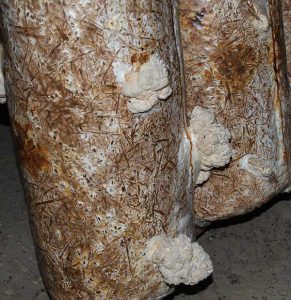
Even if the primordia grows together into one dense mass, without dividing into separate mushrooms, the quality of the mycelium is most likely not to blame.
▶️ In most cases, the real causes are:
⚠️ Any clusters that stopped growing or failed to separate into mushrooms must be removed.
✅ Follow the steaming or pasteurization schedule strictly
✅ Fill bags to optimal density — do not overcompact
⚠️ Be careful with supplements! Too much nitrogen or additives often causes malformed clusters.
Always keep a record of the additive percentages you use and the results you get. Never experiment on an entire batch at once.
⚠️ Avoid short-term spikes in temperature and humidity, especially at the final stage.
⚠️ Cold or frosty air during emergency cooling can cause water to flow under the film and disrupt gas exchange.
With excess carbon dioxide inside the bag, the mycelium may lose its ability to form normal fruiting bodies. Instead of mushrooms, growths are formed.
If other blocks in the same batch grow normally, only the affected ones were exposed to damaging conditions.
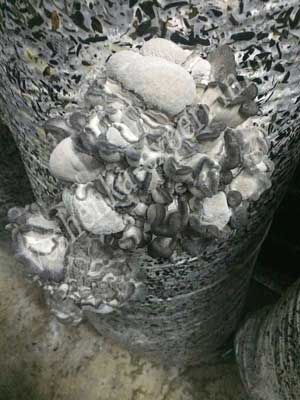
This photo from one of my readers clearly shows what happens when things go wrong.
Instead of mushrooms, there are cones or a dense mass that resembles mushrooms, but is not divided into individual fruits.
💡 Deformed primordia usually appear when several factors combine, for example:
Stable conditions are not optional — they are the foundation of normal oyster mushroom development.
Emoji guide: 📌 link | ✅ advice | ▶️ fact | 💡 important | ⚠️ warning