


The most surprising thing — something many people don’t even think about — is that most living organisms breathe oxygen from the air and release carbon dioxide and moisture.
Many people assume that plants breathe CO₂.
That’s not exactly true.
During daylight hours, plants use carbon dioxide for photosynthesis and release oxygen.
💡But respiration — the process of absorbing oxygen — doesn’t stop, day or night. Like animals and fungi, plants also need oxygen to live.
Anaerobic organisms do exist, of course — they can survive without oxygen. But when we’re talking about plants and higher fungi like mushrooms, they’re all aerobic organisms: they breathe oxygen.
Mushrooms are no exception. They absorb oxygen from the air and release carbon dioxide as part of their respiration process.
Do mushrooms produce oxygen?
No. Unlike plants or phytoplankton, mushrooms don’t perform photosynthesis, so they don’t produce oxygen.
Do mushrooms breathe oxygen?
Technically, mushrooms absorb air — a mix of gases — but what matters is that they use oxygen in their biological processes. Like all aerobic organisms, they breathe in oxygen and give off CO₂.
They also release water vapor.
In fact, mushrooms release quite a lot of it, which is why high humidity is crucial for their growth.
📌Oyster mushrooms, for example, grow best at a humidity of 75 to 93%, depending on the strain, the temperature, and the stage of development.
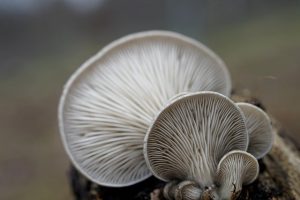
Oyster mushrooms breathe through the entire surface of their fruiting body — both the cap and the stem.
Air passes through the thin skin of the cap into the inner tissues of the mushroom, supporting the development of the fruiting body and spore formation.
The structures under the cap that resemble gills are called the hymenophore.
Nature didn’t create them for breathing. Their purpose is spore production — spores mature deep within this tissue.
💡Still, some air exchange does happen there, just as it does through the cap’s surface.
No. Since mushrooms don’t photosynthesize, they don’t use carbon dioxide for growth.
In fact, too much CO₂ can deform the fruiting body. Oyster mushrooms grown in high-CO₂ environments often develop stretched stems and misshapen caps.
 📌Take a look at what happens when CO₂ levels aren’t controlled properly.
You’ll find more information about managing CO₂ in your growing room in this article↑.
Some growers say, “Mushrooms need ventilation so they get enough oxygen.”
That’s not entirely accurate.
Normal air contains around 21% oxygen, which is more than enough for oyster mushrooms.
The problem is when CO₂ builds up. Without proper ventilation, carbon dioxide and water vapor form a layer over the mushrooms — blocking access to fresh air.
When this happens, mushrooms can’t breathe well.
They start to suffocate.
💡That’s when you’ll see long, thin stems: the mushrooms are literally reaching upward, trying to find fresh air.
Yes — absolutely. Mycelium is a living organism. As it grows, it breathes oxygen and releases carbon dioxide and moisture.
If you place mushroom blocks made on the same day in one room, the most active phase of mycelial growth usually happens around days 5 to 9.
During this time, CO₂ levels in the room can rise to 10,000–20,000 ppm.
That won’t stop the mycelium from growing — it still has enough oxygen inside the substrate bags.
But for humans, that room will feel stuffy and unpleasant, so you may want to ventilate the incubator.
✅Once the substrate is fully colonized and has turned a solid white, it’s time to start adding fresh air — slowly — to help the mycelium form hyphal knots, which later become pins (baby mushrooms).
⚠️ Just be careful:
Before primordia (pins) appear, the CO₂ level shouldn’t drop below 2000 ppm.
If it does, you may end up with loose, underdeveloped clusters and fewer mushrooms.
Once you see strong pin formation, you can gradually lower the CO₂ to the target level recommended for your strain.
Emoji guide: 📌 link | ✅ advice | 💡 important | ⚠️ warning