


If your mushroom blocks are turning black or your clusters are suddenly withering, use this troubleshooting guide to identify and eliminate common oyster mushroom pests.
Table of Contents
While adult flies or midges might seem harmless as they buzz around, they are a major threat.
 The real damage is done by their larvae (maggots), which feed on the mycelium and the mushrooms themselves.
If midges lay eggs in your substrate bags, the hatching larvae will devour the mycelial hyphae (the white mass).
If the infestation is heavy, the block will turn completely dark because the mycelium has been eaten away.
💡Some types of larvae can even reproduce within the bag continuously without ever developing into flying adults.
There are many species of pests, and their larvae vary in appearance:
Most often, mushrooms begin to wither because larvae are gnawing at the base of the cluster.
Primordia and pins become soft (like cotton wool) and turn brown or reddish-orange.
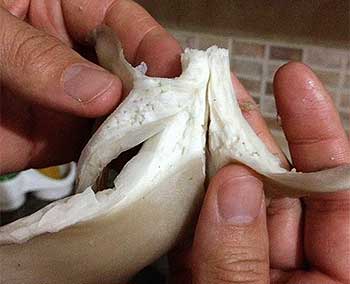
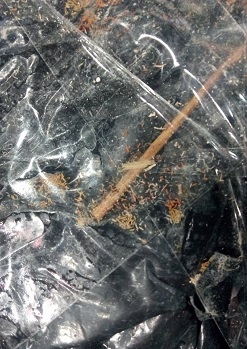
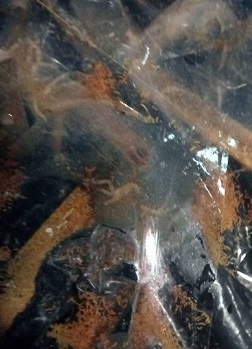
You can see larvae on the mushroom stems (see photo above) and under the plastic, on the substrate (photo below)
The "Magnifying Glass" Test:
If a cluster starts to wither, pick it and examine the base (the "butt" of the bunch). You will see tiny holes or tunnels gnawed by the larvae.
Tear out a damaged bunch with a bit of substrate.
Crush it onto a white sheet of paper and use a magnifying glass.
Alternatively, put the crushed substrate in a jar of water and hold it up to the light—the larvae will be visible in the water.
Yes. In search queries, people often look for "worms in mushroom blocks," and while I hesitate to call larvae "worms," some species look exactly like them.
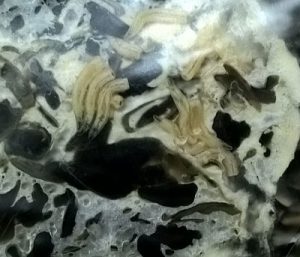
Very rarely, you might encounter real roundworms (nematodes), which are tiny (1–2 mm).
If you tear a mushroom cap along the gills and see that the flesh is perforated with tunnels, the mushroom is infested.
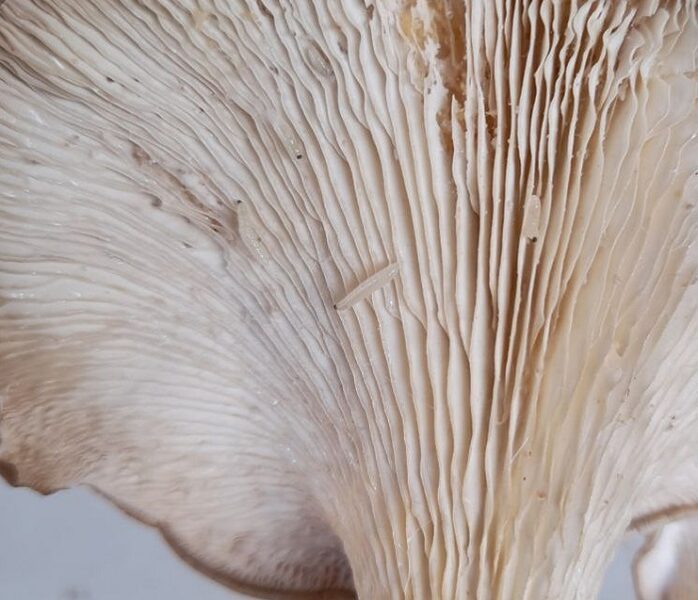
Look closely between the gills. You may see tiny white balls—these are eggs waiting to hatch.
Take a close look at this photo. I managed to spot 5 white maggots with black heads on it.
I wonder, how many can you find? 🧐
You can also see small white balls tucked between the gills—those are the eggs.
Flying parasites are attracted to specific smells. Their favorite breeding grounds include:
Here's what happens:
✅ Sanitation: Empty incubators and grow rooms should be treated with insecticides between cycles.
✅ Emergency Measures: If you find larvae in only 2–3 blocks early on, you can use aerosol insecticides or smoke bombs in the incubator.
✅ Mass Infestation: If larvae are visible to the naked eye under the film across many blocks, evacuate the entire room immediately. Remove the bags, bury the contents, and ideally, burn the plastic film.
⚠️Important! Sticky tapes and traps are for monitoring, not for total eradication. They tell you that you have a problem, but they won't solve it.
📌 Read more: How to get rid of mushroom flies
How to carry out sanitary treatments.
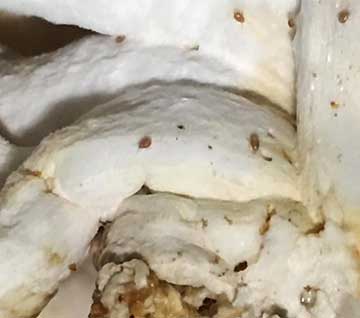
Sometimes you might see tiny red "bugs" on your mushrooms. These are Red Spider Mites.
They are arachnids, not insects.
✅ Treatment:
Use "insecto-acaricides" labeled for indoor use or greenhouses. Read the instructions carefully—the product must be safe for use inside buildings.
✅ Prevention:
These mites hate cool, humid climates. If you cannot keep your grow room cool during the summer, it is better to pause production.
If you see other accidental beetles or bugs, feel free to send me a photo via email [email protected]
Now you know what those little 'worms' and bugs are, how they can damage your oyster mushrooms, and—most importantly—how to handle these pests.😉
Stay vigilant, keep your grow room clean, and your mushrooms will thank you!
Emoji guide: 📌 link | ✅ advice | ▶️ fact | 💡 important | ⚠️ warning