


Mushroom growers around the world most commonly use grain spawn — it’s suitable both for home growing and for farm-scale production.
This is the most convenient way to introduce mycelium evenly throughout the entire depth of the substrate so that the hyphae spread in all directions at the same time. Oyster mushroom mycelium grows quickly and is able to colonize the substrate faster than harmful microorganisms.
In this article, I’ll explain which types of grain are used to produce spawn, how they differ, and whether grain can be used as a substrate for growing oyster mushrooms.
It’s the fungal hyphae that grow after inoculating a carrier with a mushroom culture (strain). These carriers can be:
▶️grain,
▶️substrate,
▶️wooden dowels.
The cultures themselves are a liquid nutrient solution containing mushroom tissue grown under sterile conditions.
Depending on the material inoculated with the culture, spawn is divided into substrate-based, grain-based, and dowel-based types.
Substrate spawn is usually made using sawdust.
Dowel spawn (also called Plug Spawn) is used for inoculating wood (logs or stumps) for outdoor cultivation.
When mushroom culture is inoculated into steamed, sterile grain, it becomes grain spawn.
💡This is called the “mother” spawn.
Once the grain is fully colonized, this mother spawn is again inoculated into fresh sterile grain: a small portion of mother spawn is mixed with sterile grain and placed in an incubator. Spawn production labs sell this fully colonized grain to mushroom growers.
Why does mycelium need grain?
Grain is highly nutritious and contains everything oyster mushroom mycelium needs for proper development.
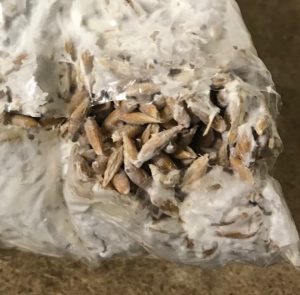
The choice of grain largely depends on your region and the cost of specific grain types. I’ll describe the pros and cons of the most commonly used grains for making spawn.
In many countries, rye is considered the best grain for spawn.
Wheat and barley are also commonly used, but many mushroom growers avoid them because they tend to overcook and stick together.
However, in many regions, these grains are simply the cheapest and most accessible, which is why they’re often chosen.
💡Many hobbyist growers prefer corn: its kernels have a dense shell and don’t get overcooked, which is especially important in home setups, as it forgives some mistakes.
Many growers believe millet produces the best spawn.
It’s small, so it offers many more growth points than other grains. That’s true — but the quality of your substrate also matters.
If you pasteurize your substrate with hot water, some contaminant spores can survive.
The oyster mushroom mycelium will consume all the nutrients from the tiny millet grain, but it won’t have enough time to colonize the substrate mass. In that case, competing molds and bacteria will have an advantage.
Personally, I believe oats make the best carrier. Oat grains are large but lightweight.
That's why a kilogram of oat spawn contains more grains than, say, wheat spawn — which means more growth points.
Oats are also very nutritious — especially the outer layer, which is quite thick.
In countries where rice is a primary agricultural crop, it’s commonly used for making spawn. Oyster mushrooms mycelium grow well on rice, too.
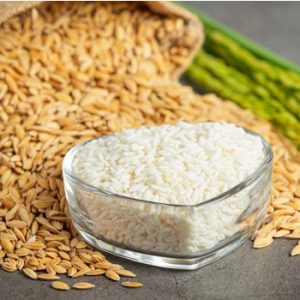
💡Important note: whatever grain you use for making spawn, it should have its hull — that is, it must be unpolished.
In this photo, you can see two types of rice: polished rice (in a glass container) and unhulled rice — that is, rice with hulls.
Yes, this is possible.
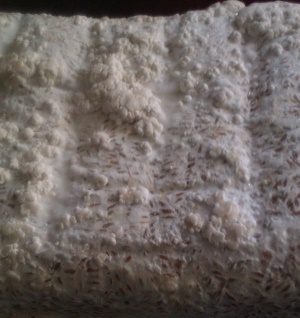
If stored incorrectly, mycelium can begin forming primordia right inside the spawn bag.
Mycelium breathes through filters. If it’s strong and hyperactive, mushroom pins can begin forming directly under the filters — this is where the most fresh air enters.
In the photo above, you can see the beginning of this process — a rounded bulge.
It consists of a dense mass of hyphae that are already ready to start producing primordia.
This spawn can still be used without problems — you’ll get blocks with high yield.
But in the next photo, you’ll see not just primordia, but whole mushroom clusters growing on the surface of the block.
The filters are torn from the pressure of growing mushrooms. Mushrooms can also appear in any place where the plastic is broken — not just under the filter.
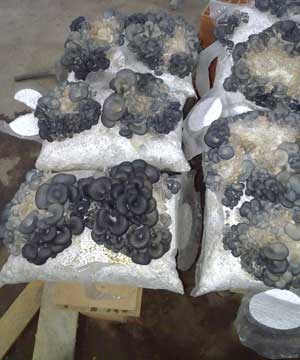 To prevent this — follow storage rules and proper temperature for grain spawn.
✅If you received such spawn after shipping — contact the producer, send them photos, and ask about possible replacement.
If, however, the spawn was stored incorrectly on your end — try tearing off the clusters, breaking apart the grains, and inoculating your substrate with a higher dose of spawn — 5–7%. Be sure to label these blocks so you can track their yield.
Usually, the yield is lower in such cases — because the mycelium has already spent energy and nutrients on forming clusters.
If you just want to grow a small batch of oyster mushrooms to eat, you can try growing them on grain alone.
Buy a bag of grain spawn and add it to grain you’ve sterilized yourself.
💡You can also try growing oyster mushrooms on unusual materials like egg cartons or toilet paper. Just add 15–20% grain spawn to these materials — there are lots of videos on YouTube showing how.
However, this method is not suitable for large-scale mushroom growing.
First of all, grain is expensive.
Second, many grain types are too rich in nutrients. Your substrate may spoil because of excess nitrogen. Bacteria that feed on nitrogen begin to release ammonia — and ammonia kills oyster mushroom mycelium.
To produce high-quality grain spawn, it’s important to consider not just the grain type, but also how it’s processed and the characteristics of the substrate it will be used with.