


If you’re searching for oyster mushroom yield per bag or trying to calculate your oyster mushroom yield per kg of substrate, you're likely trying to figure out if your project is going to be profitable.
Let’s dive into this topic.
In mushroom farming, "yield" is the weight of mushrooms harvested compared to the weight of the substrate block.
Commercial growers usually measure this in percentages. For example, if you have a 10 kg (22 lb) bag and harvest 2.5 kg (5.5 lb) of mushrooms, your yield is 25%.
While some sources talk about "100% yield," they are usually referring to dry weight (harvest weight vs. the weight of dry straw/hulls). However, it is much easier to track your oyster mushroom yield per bag in kg based on the total wet weight of the block.
Here’s how that works:
However, it is much easier to track your oyster mushroom yield per bag in kg based on the total wet weight of the block.
▶️Most of the harvest — about 60–70% — comes in the first flush. The second flush gives you another 30–40%.
After that, yield drops off. Many commercial farms don’t bother with a third flush — it takes time, space, and climate control, but gives little back.
One grow bag (about 10–11 kg/24 lb) usually needs 300–350 g (0,7 lb ~= 10 oz) of grain spawn.
That means 1 kg of spawn (2.2 lb) can inoculate around 3 grow bags, and if your conditions are good, you’ll harvest 6–7 kg (13-15 lb) of mushrooms per kilo of spawn (total of two flushes).
▶️In a well-managed facility, you can expect to get 17-20% of the weight of the block from the first flush. This equals 1.9-2.2 kg (4.2-4.8 lb) of mushrooms per bag.
If the bags are placed in a damp basement with minimal ventilation, at temperatures between 11°C (52°F) and 18°C (64°F), you can expect to harvest between 1.3 and 1.8 kg (2.9-4 lb) per bag.
Not really. More spawn means faster colonization — but not necessarily more mushrooms, especially if your substrate is already nutritious.
The only time extra spawn can help with yield is when you’re using poor-quality substrate — like straw from drought years. Then the spawn can “add” some nutrition and slightly boost the harvest.
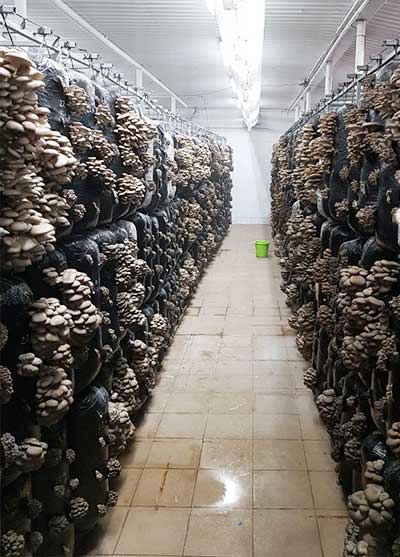 ✅There are two main ways to boost your oyster mushroom yield:
You can improve the nutritional value of your substrate mix by adding plant-based materials high in nitrogen — such as legume straw or hay, soybean straw or hulls, or sugar beet pulp.
Which supplements are best for you depends on your substrate preparation method.
📌More details here.
If you're lucky to have access to cotton by-products in your region, your yields can be especially high.
For example, many mushroom growers in Turkey harvest 27–30% of the substrate weight in a single flush and then discard the blocks.
Preventing condensation and "fog" in your grow room is key. If pins get too wet or too dry, they die, and your total harvest suffers.
If clusters only grow from some holes while others stay empty, your climate settings are likely off. High humidity without enough airflow or temperature stress often causes "aborted pins".
✅A quick trick: when you see primordia forming, put a sticky note near the empty holes. Check them in 2–3 days. If nothing grows, those spots may have failed due to poor colonization or aborted pins.
If many holes remain empty, this could significantly reduce your yield.
Keep an eye on these holes during the second flush—if large, beautiful, and heavy oyster clusters develop there, that's a good sign. If the holes are still empty, you’ll need to investigate the cause.
📌For more information, read about the optimal growing room conditions.
💡Once you know your yield per bag, you can plan your entire facility.
With a good racking system, you can expect 10–18 kg per sq.m (20–37 lbs per 10 sq.ft) per month.
I’ve created a complete planning table for grow rooms from 20 to 50 sq.m (215 to 540 sq.ft) that covers everything from electricity use to raw material needs.
📌Read this article on my website: Oyster Mushroom Yield Per Square Meter or Per 10 Square Feet
Soaking dry, spent substrate will not revive mycelium fruiting. If the mushroom blocks are dense and heavy, you may still be able to harvest a small crop of oyster mushrooms. How?
📌Read the article What to do with waste bags.
Emoji guide: 📌 link | ✅ advice | ▶️ fact | 💡 important