


Two different technologies are used in growing oyster mushrooms.
One of them assumes the presence of two types of premises with different microclimates.
In one room, which is called the "incubator" - mycelium grows in the substrate. In the second room, which is called the “growing chamber” or “mushroom grow room”, oyster mushrooms grow. When the mycelium is ready to bear fruit, the blocks are transferred from the incubator to the growing chamber.
This mushroom growing system is called a two-zone system (or technology) for growing oyster mushrooms. It is also called the "bizonal system".
Read a detailed article about the incubator and incubation here.
In another technology, blocks with a substrate are not transferred anywhere - they are always in the same room. When the substrate overgrows, the technologist changes the microclimate in this room. That is, first in this room conditions are created for fast and high-quality incubation of the substrate. Then the technologist creates conditions for growing oyster mushrooms - lowers the temperature, adds fresh air, and regulates humidity.
This mushroom growing system is called a single-zone oyster mushroom growing system. It is also called a “multi-chamber system”.
For medium-sized operations, and especially large-scale farms, it’s better to design a single-zone system from the start. It is much easier to bring individual rooms into operation gradually than to completely redo a two-zone system later.
*I define medium-sized operations as those growing at least 8–10 tons (17,600–22,000 lbs) of mushrooms per month.
This system is designed for industrial complexes of oyster mushrooms.
From 3 to 8 rooms are equipped for it, each chamber has its own climate system for ventilation, heating and humidification.
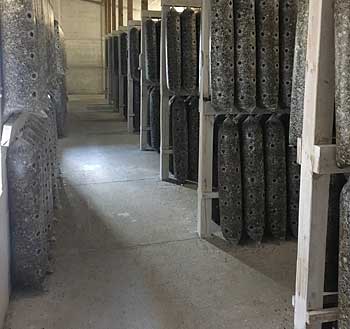
The blocks are hung (or placed on racks) in the chamber immediately after inoculation. It is desirable to fill one chamber with blocks in one day, although it is acceptable to fill the chamber within two to three days. That is, all the blocks that you made in two or three days fall into one chamber.
The microclimate parameters are adjusted to the incubation mode.
The head grower (or site technologist) adjusts the climate settings in real-time—either manually or via automated controllers—based on the current stage of mycelium growth.
After incubation, the climate is smoothly transferred to the mode of fruit formation.
After the first flush, the climate is again changed to incubation mode. So the mycelium recovers faster after fruiting and the second flush is earlier and more friendly. This technique increases the yield in two flushes up to 22-25%.
Since the bags in the single-zone system are not transferred after incubation, the substrate is not injured and the primordia are not damaged. In addition, the cost of manual labor is significantly reduced.
In such growing rooms, most often the rows are doubled. That is, two rows of mushroom blocks hang side by side and have one-sided perforation - they bear fruit on one side.
This significantly saves space and increases the load per square meter.
A full cleaning, preventive sanitation and minor repairs (if necessary) are carried out in the chamber after the removal of used bags.
1. If you buy substrate blocks in large quantities, but rarely. For example, you have three isolated premises (an old warehouse or a vegetable store).
You negotiate with a supplier to purchase 20 (or 10) tons of substrate once every two to three weeks.
You load the entire batch into a warm, empty room treated with chemicals.
Set the parameters of the climate control system to the incubation microclimate:
Read more: About humidity and temperature during incubation
Read "Optimal microclimate for growing"
2. If you prepare the substrate yourself, but rarely and immediately make a large batch. Or you have a tunnel and pasteurize raw materials once a week.
It doesn't matter how many blocks you make at a time - 500 or 1000. The main thing is that you are not going to make the next batch soon.
In this case, it will be more expensive to maintain one large incubator or three small ones than to equip 7 single-zone growing chambers.
3. If you have a dual zone system and you have verified that:
As you can see, single-zone technology has a lot of advantages. Believe me, the cost of purchasing equipment will pay off by increasing productivity.
If you are planning to set up a small business first and then grow it if “everything goes well”, I can help you plan the premises for your business. If you want to expand and increase volumes, you can inexpensively and mobilely convert the farm from a two-zone scheme to a single-zone one, without significant restructuring and high additional costs.