


Even with a good incubator, things can go wrong if the biology of the mycelium is ignored. This part covers how to avoid "local disasters" within your mushroom blocks and how to handle small batches safely.
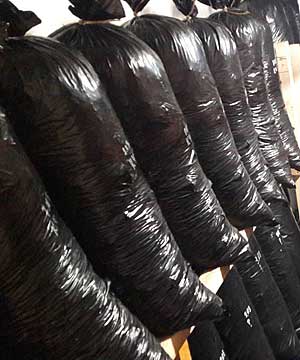
Some growers try to save energy by leaning bags tightly against each other, hoping they will "self-heat" in a cold room.
This creates uncontrollable heating. When blocks touch, heat cannot escape the surface, leading to local overheating under the film.
▶️ This usually results in uneven colonization.
You may see yellow, water-soaked spots where condensation has pooled, preventing the mycelium from growing.
In some areas of an overheated block, you might notice a dense, white, cotton-like mass.
This is stroma. It is the mycelium’s defense mechanism; it transforms into this thick layer to protect itself from excessive heat.
While it looks like healthy mycelium, it is actually a sign of stress and can interfere with future primordia formation.
📌Check out this article for a deep dive into stroma, including detailed photos.
If you are a hobbyist or have a small farm, you might not have a separate incubator.
✅Here is how to handle it:
Small Batches: If you only make 15–20 bags at a time, you cannot create a separate climate for them in a large room. The best solution is to fence off a small corner of the room with plastic film to create a "micro-incubator."
The "Curtain" Method: If you produce a large batch once a week, use hanging plastic curtains to isolate the new blocks from the fruiting area. You can use an oil heater or a fan heater inside this fenced area to reach the required 20–22°C (68–72°F).
⚠️Never leave electric heaters unattended and ensure they are not placed too close to the plastic film.
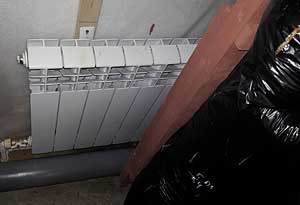
In such cases, you can also run heating radiators along the walls specifically in the fenced-off incubation compartment. At the same time, all other radiators in the rest of the room should be switched off.
💡While radiators work for incubation, they should never be used in a room where fruiting is in progress.
They dry out the air uncontrollably and create heat-driven air currents that are impossible to manage, which can quickly ruin your developing mushroom clusters.
✅Never let blocks touch.
Always maintain a gap of at least 2–3 cm (1 inch) for airflow.
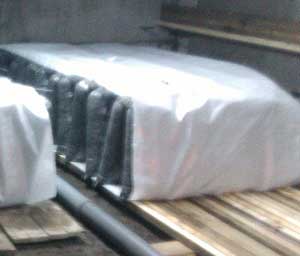
✅No Cover-ups:
Never cover blocks with oilcloth or extra film to "warm them up." This is a fast track to overheating and killing the mycelium.
📷In the photo, you can see the blocks touching only at the very top, leaning lightly against one another.
If you stack blocks together and cover them, the inner bags will overheat so much that the mycelium will die, while the outer ones will stay too cold for any growth to happen at all.
⚠️Environment First:
Only start making substrate when you are 100% sure you can maintain 20–22°C (68–72°F) and 80–85% humidity.
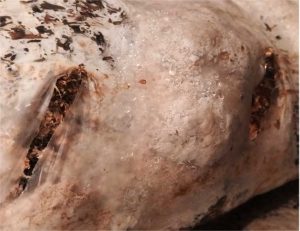 In this photo, you can see dark, empty perforations—the mycelium didn't grow toward them because the air outside was too dry.
However, notice the pins forming. Unfortunately, they are trapped under the film where the humidity is higher.
Even if you cut the plastic now, these pins are much more likely to die than to keep growing
You can find detailed breakdowns in these separate articles:
📌Best Incubation Temperature for Oyster Mushrooms
📌Optimal Humidity Levels for Incubation
Emoji guide: 📌 link | ✅ advice | ▶️ fact | 💡 important | ⚠️ warning