


I already have an article explaining what spawn is, what grain it's grown on, and why we use it when cultivating oyster mushrooms.
📌Read here.
In this one, we’ll look at choosing quality oyster mushroom spawn: signs, storage, and common pitfalls.
Table of Contents:
▶️ Good spawn is fully colonized — you should see an even white coating, though a few individual grains may still be visible.
▶️ The surface might look slightly uneven due to active growth, and you may spot small clear water droplets. These can have a slight yellow tint due to metabolic byproducts.
💡 Important! Don't confuse these clear drops with bacterial slime — that’s cloudy and smells unpleasant.
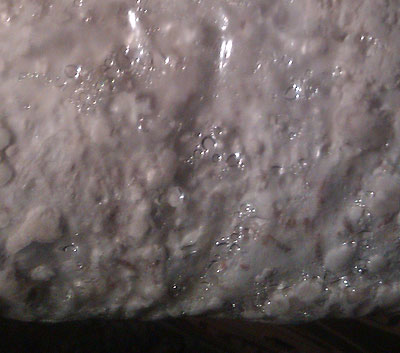
Here's a photo showing water droplets. This is perfectly normal — it’s moisture condensed from mycelium respiration.
▶️ The spawn should feel firm when pressed, but still crumble easily into individual grains when squeezed in your hand.
Sometimes, the spawn becomes so dense it's hard to break apart. You might also find large rust-colored or light brown liquid pockets under the plastic.
⚠️ That usually means the spawn was made 2–3 months ago and stored in a fridge — either at your supplier’s or your home.
High-quality oyster mushroom spawn is always bright white, regardless of the strain.
▶️ Spawn of other mushrooms like shiitake or reishi may have a faint cream or pink hue. But oyster mushroom spawn should be pure white.
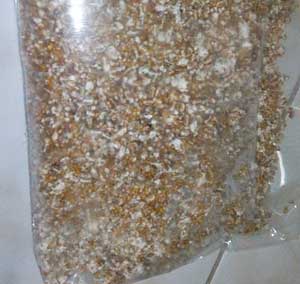
⚠️ If you see loose grains in the bag and they’re yellow-brown, the spawn is likely immature. Avoid buying such packages.
✅ But if you’ve already bought it, place the bag in a warm, clean area (never in an incubator).
At 18–22 degrees Celsius (64–72 degrees Fahrenheit), fresh spawn will usually finish colonizing and turn completely white within 3–4 days.
💡 If it gets moldy during that time, contamination happened before it reached you — it’s not your fault.
Look for jelly-like yellow-brown spots or mold in pink, green, black, or any other color — these mean it was made or stored in an unclean environment.
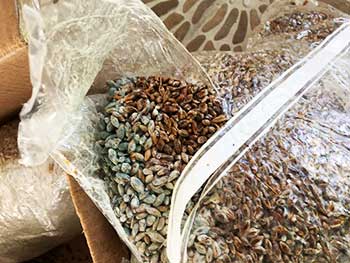
Mold usually spreads throughout the bag, not just in the visibly moldy area. Even if you remove visible spores, mold hyphae may have already spread invisibly.
💡 Early mold looks very similar to oyster mycelium — whitish or light grey. Only the spores are colorful.
▶️ Tiny black dots on your mycelium? That’s mold too — likely mucor, which forms spores on thin hair-like strands.
Mold can get into the packaging either during production — due to poor manufacturing practices or damage to the packaging — or later during storage, for example, if the plastic film was accidentally torn or punctured.
💡 Carefully inspect each bag upon delivery — it might have been damaged in transit.
✅ If you see a tear, tape it up right away.
✅ Use the spawn immediately and don’t mix it with others. Label these blocks clearly. If those blocks colonize poorly, show green mold, or smell bad — it means mold spores entered through the damaged area.
✅ If you receive spawn with visible orange, pink, black, or green spots — 📸 take photos and contact the supplier for a refund.
📌 Read more: Mold in mushroom blocks.
If the spawn has bacterial spores, you’ll see wet yellow or light brown patches with a bad smell. These spots are cloudy, not clear — that's how you can tell the difference.
⚠️ Contaminated spawn is not suitable for inoculation.
High-quality grain spawn has a very light, slightly sweet aroma — it reminds me of the smell of milk.
I’ve read online that good spawn smells like forest mushrooms. To me, forest mushrooms smell fresh and have a distinct “mushroomy” scent — but oyster mushroom mycelium does not smell like that.
⚠️ Any strong smell — sour, foul, alcoholic, medicinal, or like ammonia — means something went wrong during mycelium development. It’s a sign that the spawn is spoiled.
The spawn shouldn’t contain hard, clumped-together grain.
⚠️ If you find such a lump, don’t break it apart — the center often hides mold. Put it in a separate plastic bag.
If the spawn smells normal and the grains are white and evenly colonized, you can still use it.
✅ Just be sure to label the blocks made from it and watch how they develop. They usually grow and fruit just fine.
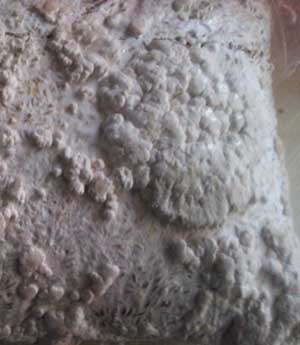
✅Keep it in the fridge, away from mushrooms and food, at 0 to 2 degrees Celsius (32 to 36 degrees Fahrenheit).
▶️ If the spawn is fresh and active, temperatures over 5 degrees Celsius (41 degrees Fahrenheit) will cause white growth to form on top of the grains.
▶️ This kicks off hyphal growth and eventually pinning — usually near filters where oxygen enters.
📸 See photo on the right.
💡 Short-term temperature changes of ±2–3degrees are okay.
❌ You can't freeze grain spawn.
If mycelium freezes (below –2 or –3 degrees Celsius), ice crystals damage the cells and the spawn loses viability after thawing.
The longer it's frozen, the more likely it is to die or weaken. Blocks made from frozen spawn may colonize but rarely fruit.
⚠️ That said, sometimes thawed spawn still performs well. So it’s your call whether it’s worth the risk.
Light isn’t necessary.
It’s fine to turn on the light briefly when you enter the fridge — just don’t leave it on.
⚠️ Continuous light may activate the spawn and cause it to grow.
▶️ Shelf life should be listed in the documentation. After that date, the supplier is no longer responsible.
Shelf life depends on storage conditions.
❌ Some warm-loving strains shouldn’t be refrigerated at all.
✅Ideally, plan your orders so you’re always working with fresh spawn.
But if you live far away and need to order in bulk, make sure you have a separate refrigerator for spawn.
As a rule of thumb, use spawn within 10–12 weeks of production.
It can last longer in the fridge — just make sure the mycelium isn’t starting to overgrow.
⚠️Golden and pink oyster spawn has a much shorter shelf life — just 2–3 weeks at 8–10 degrees Celsius (46–50 degrees Fahrenheit).
High-quality spawn is the foundation of a successful mushroom grow. By recognizing the signs of healthy and contaminated spawn — and storing it correctly — you can save time, money, and avoid major disappointment.
Emoji guide: 📌 link | ✅ advice | ▶️ fact | 💡 important | ⚠️ warning