


If you see white dust in the oyster mushroom growing room, it likely means the mushrooms are overripe and have started to release spores. These spores are extremely light and quickly spread throughout the room.
If you see white powdery mold on mushrooms (like powder), these are most likely also spores that have settled on the cap of the oyster mushroom.
If the mold looks like fluffy cotton, the oyster mushrooms have likely been in the fridge too long and have simply spoiled — like any perishable food left too long.
With aging, oyster mushrooms lose weight, so harvesting it on time, before sporulation begins, is beneficial not only in terms of health, but also economically.
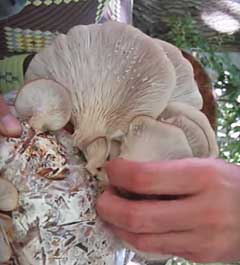
Below in the photo we see such a mushroom - small white threads hanging on the gills (hymenophore), on the bottom of the cap - these are the spores that have stuck to the hyphae of the secondary mycelium.
Table of Contents
It's a good question to ask whether growing mushrooms indoors poses any health hazard — especially when it comes to spore exposure and air quality in small spaces.
What is the danger of oyster mushroom spores?
Mushroom spores, even in small quantities, as well as pollen and seeds of some plants, can cause allergies in a person predisposed to it.
Many people work on mushroom farms for years, breathe air that contains spores and they don't have allergies.
Some workers begin to cough after a while.
And there is a small percentage of people who feel bad after being in the grow room for just a few minutes.
You may feel discomfort that indicates an allergic reaction.
Symptoms may include skin redness, fever, and fatigue — often severe enough to cause difficulty thinking clearly.
A dry cough may begin, often turning into a constant desire to clear your throat.
The lungs produce mucus that coats the spores, and the body's natural response is to cough up this mucus.
💡Antitussive syrups that thin the mucus will not help here. They even make things worse. From the immune system's point of view, the liquid mucus doesn't isolate the spores well enough, so the mucus production team comes in again.
▶️If you do not react to the cough, it will get worse and you will have chronic bronchitis.
Unfortunately, if you have such a reaction, it is unlikely that you will be able to work in the oyster mushroom growing room - you will need a worker to pick mushrooms.
If you're transporting mushrooms yourself, be sure to cover the boxes with plastic or cloth, and keep the car windows slightly open.
You need to treat a cough from oyster mushroom spores like any other allergy - contact an allergist, describe the symptoms and follow his instructions.
▶️Allergic manifestations most often mean that the liver cannot cope with the elimination of toxins. So check it out too. Also balance your diet.
Your allergist will most likely prescribe an allergy medicine for you. Be prepared for the fact that medicines, alas, will not help you.
Also, these pills don't cure allergies, they just suppress the symptoms! In other words, your body will resist less, not hurt less.
Oyster mushroom spores cannot grow in your lungs.
When they enter the lungs, the body perceives them as a foreign protein, which is enveloped in mucus and pushed out. Allergies occur only in some people prone to them.
Even then, the body reacts — but the response is exaggerated and leads to the symptoms described above.
However, this does not mean that oyster mushroom spores will live and develop in your lungs.
💡Oyster mushroom spores cannot grow in the lungs because they lack the nutrients and conditions they need to develop.
In nature, spores germinate only on suitable substrates like wood or straw, where they find moisture, warmth, and organic matter. Human lungs, while warm and moist, don’t provide the right environment for fungal growth — especially for wood-decaying species like oyster mushrooms.
In rare but serious cases, long-term exposure to spores can lead to hypersensitivity pneumonitis ((Mushroom worker’s lung) — and this might be where the myth about spores growing in the lungs comes from.
But developing such a condition requires an extremely high and constant concentration of spores in the grow room — a level that is unacceptable even from a production standpoint.
▶️When they talk about the effect of fungal spores on the lungs, they most often mean spores of lower fungi, that is, mold. Particularly dangerous is black mold Aspergillus, which causes mycoses of the lungs. However, if you follow the rules for growing oyster mushrooms, you will not encounter this mold. Since good air exchange in growing rooms does not give it a chance to grow there.
First, it is necessary to observe the optimal microclimate parameters for the strain being grown.
At high temperatures, oyster mushrooms not only grow rapidly and lose weight, but also age very quickly: they begin to produce and secrete spores.
In the summer, in the growing chamber in the mornings, there is white dust near the blocks, a fog of spores, if the mushrooms are not picked at night.
Don't let the cluster of oyster mushrooms outgrow.
✅Collect them on time, when the cap of the largest mushrooms in the joint is about 4-5, maximum 6 cm in diameter.
This way, far fewer spores will form. In summer, collect oyster mushrooms 3-4 times a day.
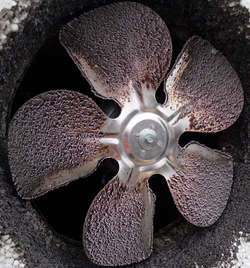
Secondly, exhaust ventilation should always work in the growing room, and not on a timer, thus you can significantly reduce the concentration of oyster mushroom spores.
▶️Especially many spores are isolated by strains of oyster mushroom pulmonaris.
Some oyster mushroom strains produce almost no spores at all. For example, Spoppo from Sylvan.
📌More about strains.
Thirdly,If you use recirculation systems as part of ventilation, you must install a spore filter of class no lower than G-3 on it. This filter must be changed and washed as it becomes dirty, once every two to three days.
Fourthly, when picking mushrooms, use a respirator yourself and force your workers!
✅If you have allergies - consider - it may be easier for you to start growing gourmet mushrooms.
Most of them don’t release heavy amounts of spores. Shiitake, pioppino, lion’s mane, chestnut mushrooms and nameko are generally safer to work with than oyster mushrooms.
This question may be asked by workers who do not have any allergy symptoms.
Show them the fan blades (see photo) and ask: do you really want to breathe in that stuff?
Explain to them that the load on the respiratory system increases in any case, even if they do not feel it yet.
Unfortunately, cough often does not appear immediately, but after some time.
Sometimes it happens that a person worked for two or three months, and then quit the mushroom farm, and two or three weeks after leaving the job he began to cough.
We never know what the long-term effects of inhaling fungal spores will be. Therefore, it is better not to risk your health.
In the American standard, this filtration class is called P100.
 Disposable respirators should be labeled FFP3.
💡These respirators are usually marked in red, pink, or purple — either on the valve, the filter, or the label.
Disposable respirators do not fit snugly to the face, so some of the spores enter the lungs. If there is a lot of spores in the growing chamber, it is better to use masks or half masks with replaceable filters.
When buying half mask respirators, pay attention to the quality of the sealant. It should be elastic silicone. The coarser rubber sealant is very difficult to fit to the shape of the face and will chafe the skin.
When buying filters, please note to the seller that you are working in a room with high humidity. You need filters coated with a water repellent.
✅After finishing work, replaceable filters must be pulled out of the mask and dried.
Ask the seller how to determine that it is time to change the filter. In any case, change it at least once a month or when you find it difficult to breathe.
I recommend mushroom growers to do yoga breathing exercises, they are very simple and do not take much time.
💡Even if you’re skeptical about yoga (and many people are), just try these three simple exercises for a week before writing them off.
These exercises are good for cough mushroom growers.
Since during breathing, the blood supply to the lungs improves and they are cleared of mucus.
Standing, raise your arms above your head through the sides, and touch your fingers. While raising your arms, inhale quite deeply, but so that your head is not spinning. Do not raise your hands quickly, measure with your breath. Then exhale slowly as you lower your arms. Repeat 6 to 8 times.
Stretch your arms forward in front of your chest. Clench into fists imaginary ropes (or rubber) that hang from the ceiling. With a deep breath, spread your arms to the sides shoulder-width apart, imagining that you are stretching imaginary ropes with effort. Spread your arms as far as possible so that the chest is fully opened. With an exhalation, bring your hands together, slightly crossing, first the right hand on top, on the next breath - the left hand on top. Extend your arms to the sides again with an inhalation. Repeat at least 6 times. But 8 times is better.
Stand up straight and exhale. Then inhale, at the same time raising the right leg to the chest, bent at the knee. You can help yourself with your hands. As you exhale, lower your leg. Repeat the exercise with the other leg.
Make sure your back is straight. And so that you raise your leg to your chest, but not lower your chest to your knee.
Start doing each exercise for one minute, 3-4 times a day. Gradually increase the time of each exercise to 2-3 minutes.
The exercises are taken from the book by Sivananda Swami “Yoga Therapy. A new look at traditional yoga therapy»
How to reduce your exposure to oyster mushroom spores.
✅ Use sporeless strains of oyster mushrooms - especially in the summer when mushrooms grow quickly.
✅ Optimize harvest timing
Pick oyster mushrooms early, while the edges of the caps are still curled down. Once they flatten out, spore release begins and quickly increases.
✅ Use airflow to your advantage and exhaust fans
Good airflow helps keep spore concentrations low — just make sure it doesn’t blow spores straight into adjacent rooms.
✅ Protect yourself
If you're harvesting oyster mushrooms frequently, wear a high-quality mask — ideally P100, N95, or a reusable mask with HEPA filters. This is especially important in small or poorly ventilated spaces.
✅ Take care of your grow room
Clean surfaces regularly, especially walls, fans, and filters. Change filters often — spores clog them fast and reduce airflow.
If you use shelves or racks, clean them thoroughly between cycles. Spores can accumulate on plastic or metal surfaces and get blown around next time.
Emoji guide: 📌 link | ✅ advice | ▶️ fact |💡important